

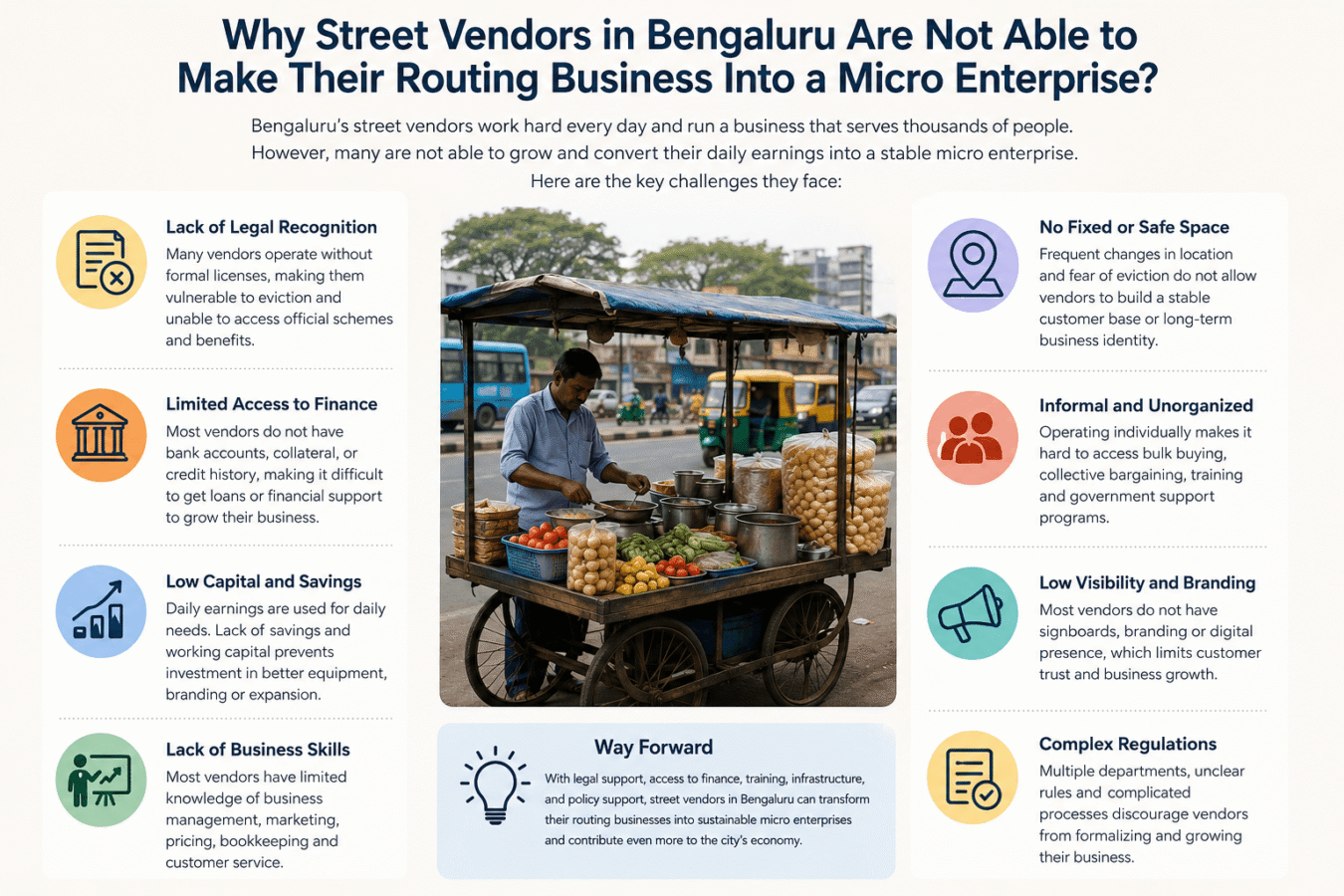

Street vendors are an integral part of urban economy. From food stalls and vegetable carts to flower sellers and small mobile shops, thousands of vendors provide affordable goods and services to city residents every day. Despite their hard work and entrepreneurial spirit, many street vendors are unable to transform their routine businesses into stable micro enterprises.
One of the major reasons is the lack of legal recognition and secure vending spaces. Many vendors operate without formal licenses or permanent locations, making them vulnerable to eviction, penalties, and constant relocation. This uncertainty prevents long-term business planning and investment.
Limited access to finance is another major challenge. Most street vendors do not have proper banking history, collateral, or financial literacy required to access loans and government credit schemes. Their earnings are mostly used for daily household expenses, leaving little room for savings or business expansion.
Lack of business knowledge and digital awareness also affects growth. Many vendors have limited understanding of branding, bookkeeping, inventory management, marketing, online payments, and customer engagement. In today’s competitive economy, the absence of these skills restricts their ability to scale operations.
Infrastructure constraints further weaken their businesses. Poor sanitation, lack of storage facilities, unreliable electricity, and absence of organized marketplaces create operational difficulties. Additionally, multiple regulations and bureaucratic procedures discourage vendors from formalizing their businesses.
Social and economic vulnerabilities also play a role. Health emergencies, inflation, family responsibilities, and unstable income cycles make it difficult for vendors to take financial risks or invest in modernization.
However, with proper policy support, financial inclusion, skill development, digital training, and organized vendor networks, street vendors in tire 1 and tier 2 cities can successfully evolve into sustainable micro enterprises. Empowering them would not only improve livelihoods but also strengthen the city’s informal economy and inclusive urban development.
Conclusion
Street vendors in cities like Bengaluru represent resilience, hard work, and grassroots entrepreneurship, yet they continue to remain economically vulnerable due to structural and institutional barriers. The problem is not a lack of entrepreneurial ability, but the absence of consistent support systems that help informal businesses grow into formal micro enterprises. With proper financial access, legal recognition, skill development, digital inclusion, and supportive urban policies, street vendors can become powerful contributors to the local economy. Empowering them is not just an economic necessity but also a step toward inclusive urban development, social equity, and sustainable livelihoods for thousands of families in cities like Bengaluru.
Disclaimer: This article is auto generated by computer programming and intended solely for informational purposes only.
